When developing a Terminator video game, the ideal scenario is to feature Arnold Schwarzenegger in his full iconic form. However, that isn't always feasible. Why is that? The developer behind an upcoming Terminator game has provided some insight.
Terminator 2D: No Fate, scheduled for release this September, is a retro-style game inspired by the 1991 action classic Terminator 2: Judgment Day. It includes familiar characters from the film like John and Sarah Connor, the T-1000, and the T-800. Watch the video below to see gameplay footage and hear from the developers at Bitmap Bureau.
Although Terminator 2D: No Fate includes both the T-1000 and T-800 characters, it does not use Arnold Schwarzenegger's likeness. In a discussion with IGN, publisher Reef Entertainment clarified the reasons, shedding light on how licensing usually works for video games.
Reef, holding the license for Terminator 2, has permission to use characters such as Sarah and John Connor from the film. Additionally, they have image rights for certain actors who granted those rights to Studio Canal, the rights holder of the first two Terminator movies, as part of the licensing agreement.
However, the license to use the Terminator character does not automatically grant the rights to use Arnold Schwarzenegger’s likeness. That's why Terminator 2D: No Fate uses the endoskeleton design for character artwork instead of Schwarzenegger’s appearance.
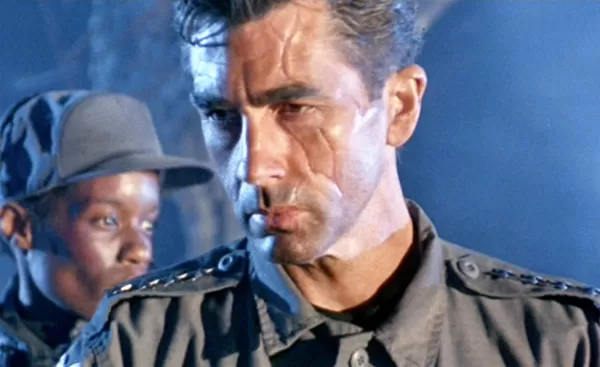
On a related note, Reef also contacted Michael Edwards, the actor who played General John Connor in Terminator 2’s memorable opening scene, to secure his likeness for the game. Terminator 2D: No Fate includes a gameplay segment in which players take on the role of Future War John Connor battling Skynet’s machines, expanding that short movie sequence into a full playable section.
In the original film, Edwards appears only briefly as John Connor, yet his performance leaves a strong impression—his scarred face and resolute expression convey the intensity of humanity's war against the machines. To include his portrayal, Reef arranged a separate agreement with the 80-year-old actor.
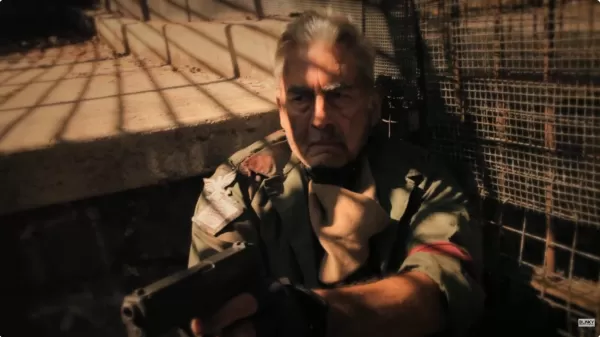
(Interestingly, Edwards returned to the role in 2021 for Skynet, a fan-created Terminator film.)
In summary, there's a distinction between securing the Terminator 2 license—which covers the use of specific characters—and obtaining the rights to an actor's likeness, which must be negotiated separately.
This isn’t to say that using Schwarzenegger’s likeness in video games is impossible. For example, Mortal Kombat developer NetherRealm has achieved this multiple times, including for the recent Conan the Barbarian DLC character in Mortal Kombat 1. Previously, they also secured Arnie’s likeness for the T-800 DLC character in Mortal Kombat 11. However, there’s a significant difference in scale between a project like Terminator 2D: No Fate and the Warner Bros.-supported Mortal Kombat franchise.
Also worth noting: while NetherRealm included Schwarzenegger’s likeness, his voice was provided by a soundalike actor, Chris Cox. It appears that Schwarzenegger, now 77, is not currently active in video game voice acting.
Here is the complete statement from Reef Entertainment to IGN explaining the licensing process:
Arnold Schwarzenegger isn't in the game; it's just the T800. Unfortunately, we did not have his likeness rights. For other actors, you need to negotiate individually for their portrait rights.
Our license gives us the right to use the characters—Sarah, John, T1000, and T800. Some actors also grant image rights to Studio Canal, which are included in the agreement. For instance, Linda Hamilton’s likeness as Sarah Connor is used, which is why she appears in the trailer. However, our rights to use the Terminator do not include Arnold’s likeness. As a result, the character artwork shows the endoskeleton design instead of his face.
Michael Edwards played the Future War John Connor in T2’s opening. You see him looking over the battlefield through binoculars. For his likeness, we reached out to him separately. There's a clear separation between the T2 license, which covers the characters, and the actors’ likeness rights, which are negotiated individually.